


So blown away by the engagement I’ve received over the last four days on Substack.
Edge Notes is a nascent project, and I’m still scrambling to get a handle of the platform as much as I am my pen.
At an editorial impasse on the Iran Ledger I’ve been working on for [redacted], I give my eyes a moment to catch their breath and find myself staring at a stack of essays and manuscripts and scribblings I’ve been accumulating with absolutely no organization whatsoever over the last year, the waves of doubt start crashing down. It makes me feel like I’m drowning in a sea of my own hubris, and I want to toss it all into the bin and light it up like a republican whose just found an oil field he doesn’t control.
So I click back over to substack to — well not really to do anything in particular — and see that Edge Notes is as of now, in dialogue with over 20 subscribers and 40 followers!
Whoa…
While it does nothing for the impasse I’m working through, it does something so much more important. It tells me that, at least in someway, some of you are already finding some value in the words ideas I’ve taken the time to share with you.
I know 20 subs and 40 followers in four days isn’t breaking any records.
But it is absolutely enough to force my nose back onto the page.
Before I get back to it though, let me grab some of the various things that have inspired me and made me think recently, to share with you — after all, Edge Notes is a project on the edge.. of something.
A project that stands in dialogue with the world, from the margins of it.
If you haven’t already, check out one of this weekend’s essays:


If you are one of the handful of people who’s seen my original intro post, you might be wondering what the liquidation of Palestine and Iran, or American politics, or whatever, has to do with the stated focus of Edge Notes.
Well, while I can promise you this won’t ever be another ‘war blog’, I did warn you, dear reader, when I wrote: [Edge Notes] rejects silos and specializations, following connections across borders and through systems: from ecology to economics, energy grids to street grids, healthcare to housing, technology to transport, land use to political economy, media systems to governance, climate to conflict, and wherever else the trail leads.
The analysis is holistic systems thinking with a structuralist bent, grounded in history and the world as it actually operates. Any solutions are born from first principles, shaped by holistic design, and tested only against the constraints of the physical world—not the imagined ones we share.
Why? How could these things be related?
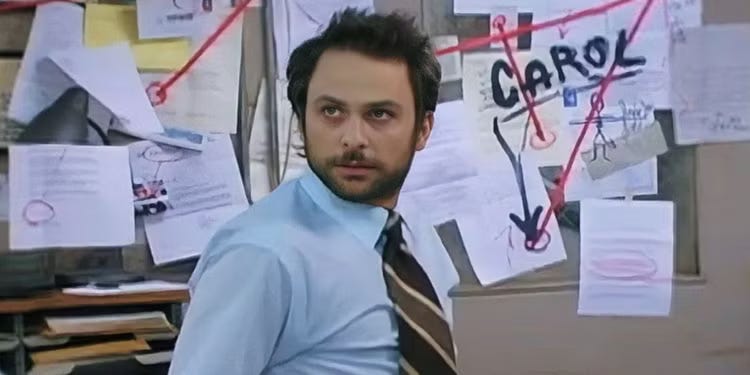
You know how…
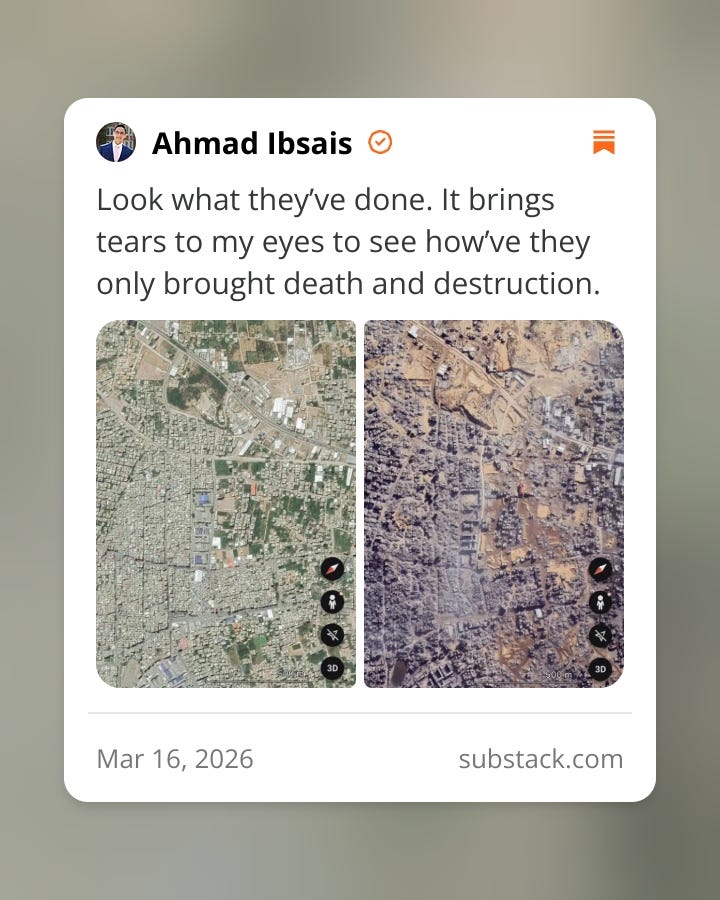
Look at this picture of Tehran Gaza — what do you see?
(Credit: Ahmad Ibsais)


Look at these pictures of Tehran — what do you see?
I see war, I see environmental destruction, I see the long lasting human health impacts of that, I see the economic impacts of reconstruction, I see the indirect deaths that WILL result from bombed out roads much less bombed out hospitals.
I see a 2,500 year old civilization being leveled by a 250 year old country, because they dared to reach for the cleanest, safest energy available.
And that (and more) is what Edge Notes is about. Not war, not the news cycle, not — god strike me dead — politics. But the space between all of these things.
In a lot of fields, edges are extremely important places. In ecology, the edges are where different biomes collide resulting in more diversity and life than in either individual space. On the map, edges are constructs, they don’t exist in real life outside of short jaunts of wall or spaced outposts; and it’s these imagined edges where real cultures collide resulting in more diversity and better food than in either individual culture.
In science or research the edge is usually where the most novel discoveries and breakthroughs happen.
So I’m writing to you from the edge.
But not just because edges are cool, but also because the center is usually a bit stale, and often… a little rotten.
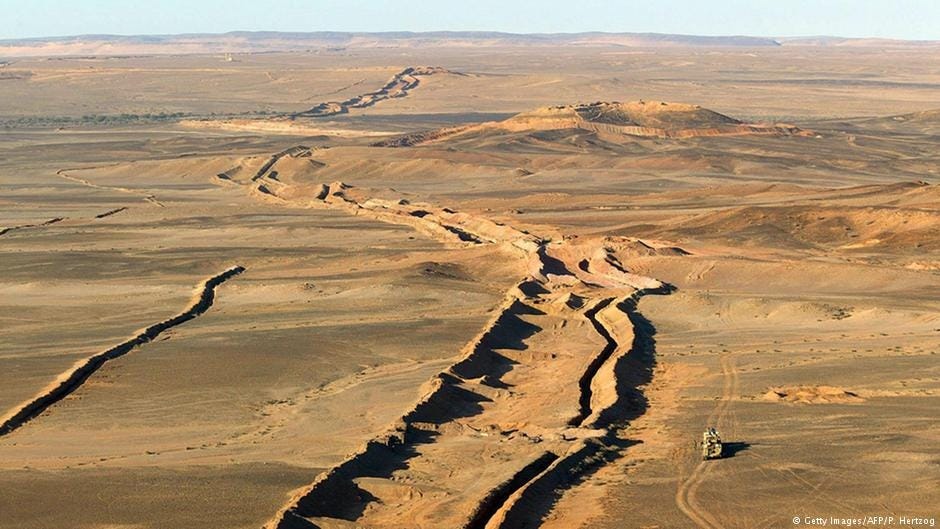
I was reading Liz Loh-Taylor’s piece, Western Sahara Explained: A Decolonisation That Never Happened, and was reminded of some really interesting facts about where she’s headed.
She’s headed to “a remote corner of the Algerian desert where around 170,000 Sahrawi refugees have lived in exile for nearly half a century.” She goes on to talk about the history of the place, including the Moroccan Wall of Shame:
“Morocco built a massive sand wall known as the berm during the war in the 1980s.
Stretching roughly 2,700 kilometres across the desert, it cuts Western Sahara in two.
On one side lies the territory controlled by Morocco. On the other lies the sparsely populated area controlled by the Polisario Front.
The wall is surrounded by one of the largest minefields on earth.”
Can you imagine a jagged mound of sand and rock rubble running roughshod right over nearly 3k km?
Splitting the land.
The people.
The flora and fauna.
Can you imagine the effects this has had on absolutely everything over the last nearly 50 years since construction began?
That’s exactly the kind of question that Edge Notes is made to ask, and try to answer.
When I read that she was en-route to Tindouf, this song started playing in my head:
So I pulled it and shared it with her.
Despite my many years of foreign languages — including french, my ancestral tongue (though the Parisians would not be pleased to hear me call it french) — I’m still just an Ugly American limited to english.
So I had to pull the lyrics and translate them to give her a serviceable answer when she asked me what the song meant.
The lyrics alternate between French and Tamashek, something like:
C’est la vie, c’est la vie
(This is life, this is life)
Parfois je me demande si ça finira ainsi
(Sometimes I wonder if it will end like this)
Parfois je me demande si ça finira un jour
(Sometimes I wonder if it’ll ever end)
Parfois je me demande si ça finira comme ça
(Sometimes I wonder if it will end like this)
C’est la vie, c’est la vie
(This is life, this is life)
Aghrayitmanine edag dilane
(My thoughts are lost in what exists)
Adanmarhine garessane ayine uksane
(Let us be patient among the things we fear)
Ayine uksane wagaressane felaratane
(Those fears that lie between us and our dreams)
v2 and chorus repeat
C’est la vie
We could — and will in the future — dive into culture as much as anything else, but I’ll spare you that level of analysis for now, and instead just ask:
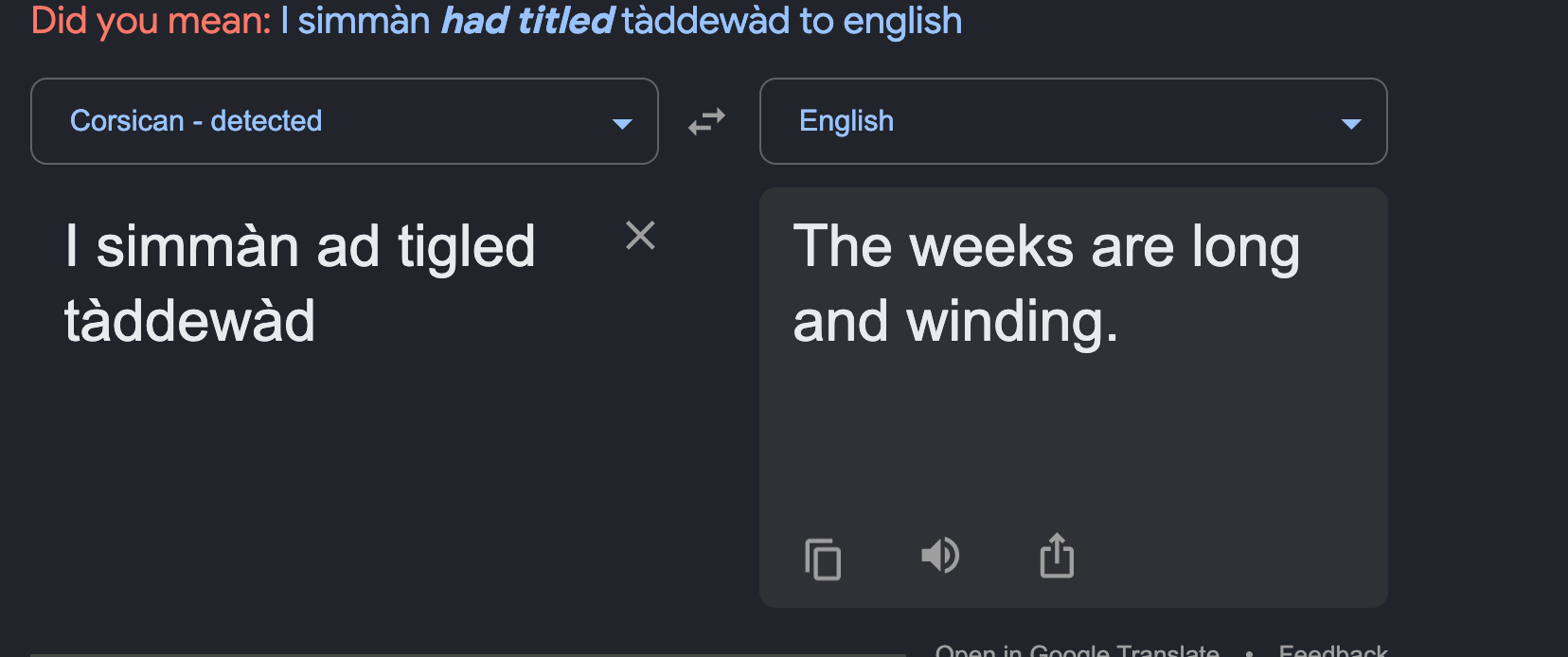
WTF?!?
Are Corsican and Tamashek related languages?
And why does it just look like Irish to me?
(Don’t tell the Corsicans I said this, but I know we’ve got a croissant in the crowd and maybe she could explain what’s going on here.)
At the end of the day, Edge Notes is just a project for annoyingly curious people, who want the world to live up to its potential, and know that for that to happen, we need to understand the mechanics of what’s actually taking place.
And that’s a tough job.
It’s also, very often, very soul-crushing.
Very isolating.
So I try to pause and enjoy the beauty too every once in a while.
But still, it can be hard to connect, right?
Especially with those who don’t see what you see, or even bother looking.
That’s why I find great solace in my homie that doesn’t know me, Viktor Patraskan.
Who really undersells himself when he says he’s “a pretentious stand up comedian from Romania.”
After watching Israeli’s PERSONALLY set a man on fire, SWERVE to punt a little girl with a car, and the thousands of other horrendous things I’ve digitally witnessed over the last 24 hours alone, Viktor’s comedy is my safe space.
While on tour (in Europe now) he’s not just filming his sets, but he’s producing a travel series with interviews of locals, history lessons, jokes; the whole nine.
With everything going on, I’ve been thinking a lot about the Iranian people whom I love dearly.
And one of my favorite Persians — and an absolute UNIT of knowledge, musicianship, and communication; Farya Faraji, has a video which I would make mandatory viewing for the entire world if I could.
It’s about so much more than the title indicates.
And explaining what I mean by that is its own essay.
So just watch it, and we can all talk about it later.
One question that’s been rolling around in the hollow between my ears lately, is how much of Orientalism can we attribute to the representation of people in art being haram?
If a culture can’t represent itself in the arts, that creates some sort of representational power vacuum, right?
Where the only lens a people and their culture can be viewed through is inherently external?
If you know the answer to any of these questions, I’d love to hear ‘em.
If you have any questions, I’d love to hear those too.
I have a lot more stuff I wanted to share with you in this post — but at this point it would just bring the mood down. So I’m going to quit while I’m ahead and sign off.
That’s it for this first installment of The Common Band, a weekly kind-of ‘personal blog’ here on Edge Notes where I get to be a hell of a lot more unfiltered and indulgent than in the essays.
Thanks for joining me on this journey.
Thanks for making my first weekend on Substack as wonderful as its been.
I hope you’ll leave a comment with a little bit about yourself, your interests, or why you read all of this. And I hope you’ll stick around.
- S.L’Errance — Edge Notes
P.S. Here are some threads to pull at with great stuff on the other end:
SAIL breaks down international law for stupid people like me, and has been very kind
Kathy Gannon’s post on Christian Nationalism is essential reading
Arturo Dominguez is keeping me up to date on the important latin american issues
The Drey Dossier is doing god’s work on AI threats
Shane Fitzgerald has some great analysis buried under solid prose
Liz Loh-Taylor whose post I referenced in the body you should go and read now

Thank you for writing this and sharing the comedic relief. We perhaps underestimate the value in comedy.